The Bitcoin halving is one of the key events built into the Bitcoin protocol. Approximately every four years, the block subsidy received by miners for adding new blocks to the blockchain is reduced by half.
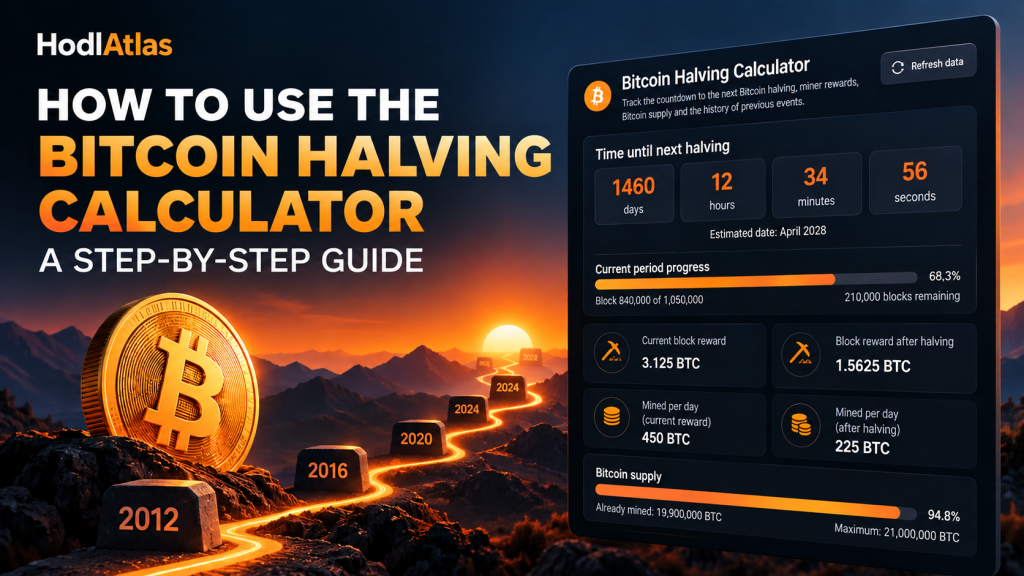
The HodlAtlas Bitcoin Halving Calculator lets you track the next halving, view the current and future block subsidy, estimate the rate of new BTC issuance, and follow the progress of the current halving cycle.
Unlike many other calculators, there is almost nothing to enter manually. The main network data and calculations are displayed automatically.
In this guide, we’ll explain how to use the calculator and what each indicator means.
What Is the Bitcoin Halving?
New bitcoin enters circulation as part of the block reward received by miners when new blocks are added to the blockchain.
The Bitcoin protocol is designed to gradually reduce this new issuance.
Every 210,000 blocks, the block subsidy is cut in half. This event is known as the Bitcoin halving.
The block subsidy has decreased over time:
50 BTC when the network launched;
25 BTC after the 2012 halving;
12.5 BTC after the 2016 halving;
6.25 BTC after the 2020 halving;
3.125 BTC after the 2024 halving.
After the next halving, the block subsidy will be reduced again to 1.5625 BTC per block.
This mechanism is built into Bitcoin’s protocol and gradually reduces the rate at which new BTC is created.
Why Use a Bitcoin Halving Calculator?
The next Bitcoin halving does not occur on a predetermined calendar date.
Instead, it is tied to a specific block height.
Because the actual time between blocks varies, the exact date of a future halving cannot be known far in advance.
The calculator makes this process easier to understand by showing:
the estimated time remaining until the next halving;
the estimated halving date;
progress through the current halving cycle;
the current block subsidy;
the block subsidy after the next halving;
the approximate amount of new BTC issued per day;
the progress of Bitcoin’s total issuance.
You can also view information about previous and future halvings.
Step 1: Check the Countdown to the Next Halving
At the top of the calculator, you will see a countdown to the next Bitcoin halving.
It displays the estimated remaining time in:
days;
hours;
minutes;
seconds.
The calculator also shows an estimated date for the event.
It is important to understand that this countdown is an estimate, not a fixed schedule.
Bitcoin itself does not use a calendar date to trigger the halving. The event occurs when the network reaches the required block height.
For this reason, the estimated date can change over time.
Why Can the Estimated Halving Date Change?
Bitcoin targets an average block interval of approximately 10 minutes.
However, individual blocks can be found faster or slower than this average.
If blocks are produced slightly faster over a period of time, the estimated halving date may move closer.
If blocks are produced more slowly, the estimated date may move further away.
The calculator therefore updates the expected timing based on the current state of the network.
As the halving approaches, the estimated date generally becomes more precise.
Step 2: Check the Current Cycle Progress
Another section of the calculator shows the progress of the current halving cycle.
A halving occurs every 210,000 blocks, so this section shows how much of the current cycle has already been completed.
The calculator can display:
the current block height;
the target block for the next halving;
the number of blocks remaining;
the percentage of the current cycle completed.
This allows you to track the next halving not only by estimated calendar time but also directly through Bitcoin blocks.
Ultimately, it is the block height that determines when the halving occurs.
Step 3: Compare the Block Subsidy Before and After the Halving
The calculator displays the current block subsidy and the subsidy expected after the next halving.
For example:
Before the halving: 3.125 BTC per block
After the halving: 1.5625 BTC per block
This means that the amount of newly created BTC miners receive through the block subsidy is reduced by half.
The halving does not reduce the amount of Bitcoin that already exists, and it does not cut the BTC held in users’ wallets in half.
It only changes the rate at which new bitcoin is issued through the block subsidy.
Step 4: See How Much New BTC Is Issued Per Day
The calculator also shows the approximate amount of new bitcoin issued per day at the current block subsidy.
With an average block interval of approximately 10 minutes, the Bitcoin network produces roughly 144 blocks per day.
At a subsidy of 3.125 BTC:
144 × 3.125 BTC = 450 BTC per day
After the subsidy falls to 1.5625 BTC:
144 × 1.5625 BTC = 225 BTC per day
The next halving therefore approximately halves the rate of new BTC issuance through the block subsidy.
The actual number of blocks mined on any individual day can vary, so these daily figures should be treated as estimates.
Step 5: Check Bitcoin’s Issuance Progress
Bitcoin has a maximum supply of 21 million BTC.
The calculator shows the progress of Bitcoin issuance, including:
how much BTC has already been mined;
the percentage of the maximum supply already issued;
Bitcoin’s maximum supply.
As additional halvings occur, progressively fewer new BTC enter circulation through the block subsidy.
The combination of a limited maximum supply and a predetermined issuance schedule is one of the defining characteristics of Bitcoin’s monetary model.
Step 6: Explore Bitcoin Halving History
The calculator also allows you to look at previous Bitcoin halvings.
The history clearly shows how the block subsidy has changed over time.
Bitcoin began with a subsidy of:
50 BTC
After each halving, it decreased:
50 → 25 → 12.5 → 6.25 → 3.125 BTC
The next stage is:
3.125 → 1.5625 BTC
This illustrates that the halving is not a one-time event. It is a recurring mechanism built into the Bitcoin protocol.
What Happens to Miners After a Halving?
After a halving, the block subsidy received by miners is reduced by half.
This directly changes the structure of mining revenue.
However, miners can receive more than newly issued BTC. The total block reward can also include transaction fees paid by users whose transactions are included in a block.
As the block subsidy continues to decline over time, transaction fees may become an increasingly important part of mining economics.
A halving also does not necessarily mean that every miner’s revenue will automatically fall by exactly 50%.
Mining economics can also be affected by:
Does the Halving Affect the Bitcoin Price?
A halving reduces the rate at which new BTC is created, but this does not mean that the Bitcoin price must rise after the event.
The market price of Bitcoin is influenced by many factors, including:
supply and demand;
global economic conditions;
market liquidity;
investor and user behavior;
regulation;
development of Bitcoin infrastructure;
other economic and market factors.
Historical Bitcoin performance around previous halvings can be interesting to study, but past results do not guarantee that the same pattern will occur again.
The Bitcoin Halving Calculator is therefore not a Bitcoin price prediction tool.
What Does “Refresh Data” Do?
The calculator uses current network information to estimate the number of blocks remaining and the approximate time until the next halving.
The “Refresh Data” button retrieves updated values and recalculates the relevant indicators.
This can be useful if the calculator page has been open for some time.
After refreshing, the countdown, cycle progress, and estimated halving date may change slightly.
Why Does New BTC Issuance Keep Getting Smaller?
The interval between halvings remains the same in terms of blocks — 210,000 blocks.
However, the absolute amount by which the block subsidy decreases becomes smaller with every halving.
For example:
50 → 25 BTC — a reduction of 25 BTC.
6.25 → 3.125 BTC — a reduction of 3.125 BTC.
3.125 → 1.5625 BTC — a reduction of 1.5625 BTC.
This process will continue until the block subsidy eventually becomes effectively zero.
Under Bitcoin’s current protocol rules, the final fractions of bitcoin are expected to be mined around 2140.