
You already own some Bitcoin, and sooner or later an important question comes up: where should you keep it?
When the amount is still small, buying a separate device that costs dozens of dollars may seem unnecessary. Why buy a hardware wallet if you currently own only $100 or $500 worth of Bitcoin?
On the other hand, if you plan to buy Bitcoin regularly for several years, what is a small amount today could eventually become much more significant.
So instead of asking:
“At what amount do I absolutely need a hardware wallet?”
a better question is:
“When does the additional security of a hardware wallet make sense for me?”
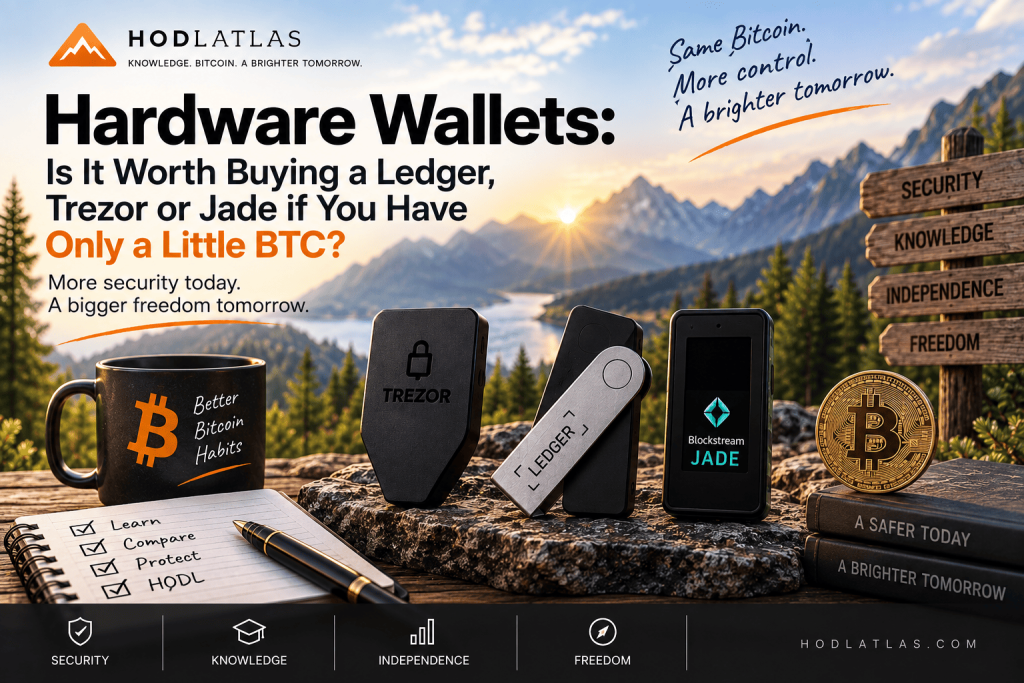
In this article, we’ll look at what a hardware wallet actually does, when buying one makes sense, when you may be fine without one for now, and how popular options such as Ledger, Trezor and Jade differ.
Important: This article is for educational purposes only. Self-custody gives you greater control over your Bitcoin, but it also makes you responsible for protecting your keys and recovery backup.
What Does a Hardware Wallet Actually Store?
Let’s start with a common misconception.
Your Bitcoin is not stored inside your Trezor, Ledger or Jade.
Bitcoin exists on the distributed ledger maintained by the network, while your wallet manages the keys that allow you to authorize transactions.
The main purpose of a hardware wallet is to isolate private keys from a general-purpose computer or smartphone and sign transactions in a more protected environment.
When you want to send Bitcoin, software on your computer or phone prepares the transaction, while the hardware device is used to verify and sign it.
Under normal operation, the private key does not need to be exposed to the computer.
That is the core advantage of a hardware wallet.
Why Is a Regular Phone or Computer Less Protected?
A non-custodial software wallet can also give you full control over your keys.
But a smartphone or computer is a general-purpose device.
It may simultaneously run:
a web browser;
email;
messaging apps;
dozens of applications;
browser extensions;
downloaded files and documents.
The more software and internet interaction a device has, the larger its potential attack surface.
A hardware wallet, by contrast, is designed primarily for one purpose — protecting keys and confirming transactions.
That does not make it invulnerable, but it significantly changes the security model.
Is There a Specific Amount After Which a Hardware Wallet Becomes Necessary?
No.
There is no universal rule that says:
“Once you have $500, buy a hardware wallet.”
Or:
“Your hardware wallet should cost no more than 10% of your Bitcoin holdings.”
Rules like these may sound convenient, but security does not work that way.
Imagine two people.
The first currently owns $300 worth of Bitcoin, but plans to buy another $100 every month for several years.
The second owns $1,000 worth of Bitcoin, does not plan to increase the position, and is comfortable using a trusted non-custodial software wallet for now.
Which one needs a hardware wallet first?
The answer is no longer so obvious.
It is better to consider several factors.
When Does a Hardware Wallet Make Sense?
1. The Amount Has Become Significant to You
There is no universal number.
$500 may be a small amount for one person.
For someone else, losing $500 would be a serious financial problem.
A better question is:
“How painful would it be for me to lose this Bitcoin?”
The more significant the amount is to you, the stronger the case for investing in additional protection.
2. You Plan to Hold Bitcoin for Several Years
The longer your holding period, the longer your keys need to remain protected.
If Bitcoin is part of a long-term plan, using a dedicated device to protect your keys becomes increasingly reasonable.
3. You Buy Bitcoin Regularly
Today you may have $200.
After several years of regular purchases, that amount could be much larger.
In this situation, you can buy a hardware wallet in advance, rather than waiting until you cross some imaginary threshold.
There is another advantage: learning self-custody with a small amount is usually less stressful than setting up a hardware wallet for the first time after your holdings have already become substantial.
4. Your Bitcoin Is Held on an Exchange or Another Custodial Service
If your Bitcoin is held on an exchange, the keys are generally controlled by the service rather than by you.
This is where the well-known principle comes from:
Not your keys, not your coins.
A hardware wallet allows you to move toward self-custody, where you control the keys.
But there is another side to that freedom: the responsibility also becomes yours.
What If You Only Have a Very Small Amount of Bitcoin?
Buying a hardware wallet after your first $20 of Bitcoin is not necessarily a priority.
For a small amount, a trusted non-custodial software wallet can be a reasonable intermediate step, provided you understand how to use it safely.
It gives you an opportunity to become familiar with:
a seed phrase or another recovery-backup method;
Bitcoin addresses;
receiving and sending BTC;
transaction fees;
the basics of self-custody.
Later, as your holdings grow or you decide you want stronger isolation of your keys, you can move to a hardware wallet.
The important thing is to understand the difference between:
“I don’t have a hardware wallet yet”
and
“I don’t control my keys at all.”
Those are not the same thing.
A Hardware Wallet Does Not Remove Your Responsibility
A hardware wallet is not a magic safe.
You can buy an expensive device and still lose your Bitcoin because of a mistake.
For example, you could:
lose both the device and the only recovery backup;
give your seed phrase to a scammer;
enter your seed phrase on a phishing website;
keep your only backup in an unsafe place;
fail to verify the recipient address before confirming a transaction.
Security therefore does not begin with buying a device.
It begins with understanding what you are protecting and how wallet recovery works.
Never use a seed phrase that was already included in the box, printed on a card, or provided to you by a seller.
Your recovery secret should be generated as part of the wallet setup process and should be known only to you.
Ledger, Trezor or Jade — Which One Should You Choose?
All three are hardware-wallet options, but their approaches to security, features and usability differ.
Trezor
Trezor is one of the best-known hardware-wallet manufacturers.
For example, the Trezor Safe 3 is designed to provide a relatively straightforward transition from software wallets to hardware-based key protection.
Bitcoin-only firmware options are available for users who intend to use the device exclusively with Bitcoin.
Trezor also places a strong emphasis on an open-source approach.
For beginners, another advantage is its relatively straightforward setup process and extensive educational documentation.
Blockstream Jade
Blockstream Jade is particularly focused on Bitcoin.
It may appeal to users who value Bitcoin-specific functionality and want the option to explore more advanced self-custody setups over time.
Depending on the Jade model and setup, QR-based workflows can be used to interact with compatible wallet software without relying on a conventional USB connection for transaction signing.
This can be useful for people who eventually want to explore self-custody in greater depth.
Ledger
Ledger Nano S Plus is another widely known hardware wallet.
It uses a dedicated Secure Element and can work with desktop systems and Android devices through USB.
Ledger supports many different crypto assets, so its approach differs from devices or configurations focused primarily on Bitcoin.
If your goal is Bitcoin only, support for many additional assets may be useful to you — or it may simply be a feature you do not need.
Which One Is Best?
There is no universal winner.
Instead, consider questions such as:
Do you need Bitcoin only, or do you also want support for other assets?
How important is an open-source approach to you?
Do you prefer USB or QR-based workflows?
Do you understand the device’s recovery process?
Are you comfortable with the manufacturer’s software?
Do you understand the security model behind the device?
For a beginner, the best choice is often not the device with the longest feature list.
It is the device whose operation and recovery process you actually understand.
Buy Your Device From a Trusted Source
A hardware wallet is directly involved in protecting the keys that control your Bitcoin, so the source of the device matters.
A sensible approach is to buy directly from the manufacturer or from a seller officially listed or authorized by the manufacturer.
Be especially careful with second-hand devices.
Regardless of where you purchase the wallet, follow the manufacturer’s official setup instructions carefully.
And once again:
Never use a seed phrase that someone else prepared for you.
DCA and Hardware Wallets: An Important UTXO Consideration
Suppose you buy $20 worth of Bitcoin every week.
Your first thought might be:
“After every purchase, I’ll immediately send the Bitcoin to my hardware wallet.”
From a key-control perspective, that idea is understandable.
But there is another factor to consider — UTXOs.
In simplified terms, UTXOs can be thought of as separate pieces of Bitcoin that can later be used as inputs when creating a new transaction.
If you repeatedly withdraw very small amounts using separate on-chain transactions, your wallet may gradually accumulate many small UTXOs.
Later, when you want to send a larger amount, a transaction may need to use several of those UTXOs as inputs.
Why Can Many Small UTXOs Increase Transaction Fees?
Bitcoin transaction fees are not simply calculated as a percentage of the amount being sent.
They depend primarily on the transaction’s data size and the current fee rate on the Bitcoin network.
The more inputs a transaction needs, the more data it will generally contain.
That means it can cost more when network fee rates are high.
For this reason, a strategy such as:
“Buy $10 → withdraw immediately → buy another $10 → withdraw again”
is not always optimal.
Especially if it continues for years.
Does That Mean You Should Keep Bitcoin on an Exchange Until You Have a Large Amount?
Not necessarily.
There is no universal answer.
On one hand, frequent small on-chain withdrawals can create many small UTXOs and potentially increase the cost of future transactions.
On the other hand, leaving Bitcoin with a custodial platform means accepting the risks associated with that platform.
The goal is therefore to find a reasonable balance between:
third-party custody risk
and
efficient UTXO and fee management.
One person may prefer to withdraw after accumulating a certain amount.
Another may withdraw more frequently because self-custody matters more to them than potentially reducing future transaction costs.
Again, there is no magic number.
Can Small UTXOs Be Consolidated Later?
Yes.
If your wallet contains many small UTXOs, they can be combined into a larger UTXO through a consolidation transaction.
People often choose to do this when network fee rates are relatively low.
But there is another consideration: consolidation can affect privacy because previously separate UTXOs may become linked together in the same transaction.
For that reason, UTXO consolidation should also be done intentionally, with an understanding of what the transaction is doing.
A Practical Path for Beginners
Imagine someone who is just starting to buy Bitcoin.
Stage 1. First Small Purchases
The amount of Bitcoin is still small.
The person learns the basics, becomes familiar with non-custodial wallets, learns how to receive and send BTC, and understands how wallet recovery works.
Stage 2. Regular Accumulation
A long-term DCA plan begins — for example, $20 or $50 per week.
It is now clear that after several years, the amount could become much more significant.
At this stage, buying a hardware wallet in advance and learning how to use it with a small amount can make sense.
Stage 3. Hardware-Based Key Protection
Long-term holdings are moved to a wallet protected by a hardware device.
The user now understands:
how to receive Bitcoin;
how to verify an address;
how to sign a transaction;
where the recovery backup is stored;
how to restore the wallet if the device is lost.
Stage 4. UTXO Management
As the amount of Bitcoin grows, the user begins to pay attention not only to the amount of BTC held, but also to UTXO structure and the potential cost of future transactions.
Self-custody therefore becomes more than simply buying a device.
It becomes a skill that develops over time.
Is It Worth Buying a Hardware Wallet in Advance?
If you are confident that you plan to accumulate Bitcoin regularly for several years, there can be good reasons to do so.
Not because your first $100 of Bitcoin automatically requires a dedicated device.
But because you can:
learn how the hardware wallet works without pressure;
make a small test transaction;
verify your recovery process;
get used to checking addresses on the device screen;
build a proper storage system before your holdings become significant.
Learning security is usually easier when a mistake does not yet put a large amount of money at risk.
When Can You Wait?
A hardware wallet may not be your highest priority yet if:
your Bitcoin holdings are still very small;
you are only beginning to learn how Bitcoin works;
you use a trusted non-custodial wallet;
you do not yet understand how to protect a recovery backup;
the cost of the device is disproportionately high compared with your current holdings.
You should not buy a hardware wallet simply because someone online says:
“A real Bitcoiner must own a hardware wallet.”
Security is not a competition.
How Do You Know When It Is Time?
Ask yourself a few questions:
1. Would losing this amount of Bitcoin be a serious problem for me?
2. Do I plan to continue buying Bitcoin for several years?
3. Do I currently control my own keys?
4. Do I understand how to protect my recovery backup?
5. Am I prepared to take responsibility for restoring my wallet if necessary?
6. Is the cost of the device reasonable compared with the value of the additional protection it provides to me?
If most of your answers point toward long-term self-custody, a hardware wallet may be a logical next step.
Understanding Matters More Than the Price of the Device
You can buy an expensive hardware wallet and still use it insecurely.
Or you can begin with a small amount, learn how Bitcoin works, and gradually build a robust self-custody setup.
So the most useful question is not:
“How much Bitcoin do I need before I should buy a hardware wallet?”
It is:
“Is this Bitcoin valuable enough to me that I want to take its security into my own hands — and am I ready for that responsibility?”
Summary
✅ There is no universal amount of Bitcoin after which a hardware wallet suddenly becomes mandatory.
✅ A hardware wallet helps protect private keys, but it does not remove your responsibility for backups, address verification and your own actions.
✅ With regular Bitcoin purchases, storage security is not the only consideration: many very small withdrawals can create numerous UTXOs and potentially increase the size and cost of future transactions.
✅ If you plan to accumulate Bitcoin for years, learning to use a hardware wallet with a small amount can make sense before your holdings become significant.


Support the Project
HodlAtlas is free, ad-free, and has no affiliate links to exchanges — the site runs on voluntary donations from people who found the tools useful. If you'd like to support its development, you can send any amount in Bitcoin.
hodlatlas@walletofsatoshi.com