
When people start learning about Bitcoin, one of the first words they hear is blockchain. There are plenty of complicated explanations surrounding this term, but the basic idea is actually quite simple.
The Bitcoin blockchain is a way to store the history of transactions without relying on a single bank, company, or central server.
Let’s look at how it works, why blocks and nodes are important, and why changing Bitcoin’s confirmed history is extremely difficult.
The Main Problem of the Traditional System: Middlemen
Imagine you want to send $100 to a friend over the internet. Normally, you need a middleman — such as a bank or payment provider.
The bank maintains its own database: how much money is in your account, who you sent money to, and when the transaction took place.
This system is convenient, but it requires you to trust the middleman.
There are several important characteristics of this model:
- The middleman has control. A bank or payment provider can reject a transaction, temporarily restrict an account, or request additional information.
- There is centralized infrastructure. If part of the banking system becomes unavailable, users may temporarily lose the ability to make transactions.
- You have to trust the middleman’s records. The bank maintains the database and determines which records are considered valid.
Bitcoin offers a different approach: instead of relying on a single central middleman, it uses a distributed network of independent participants.
What Is Blockchain?
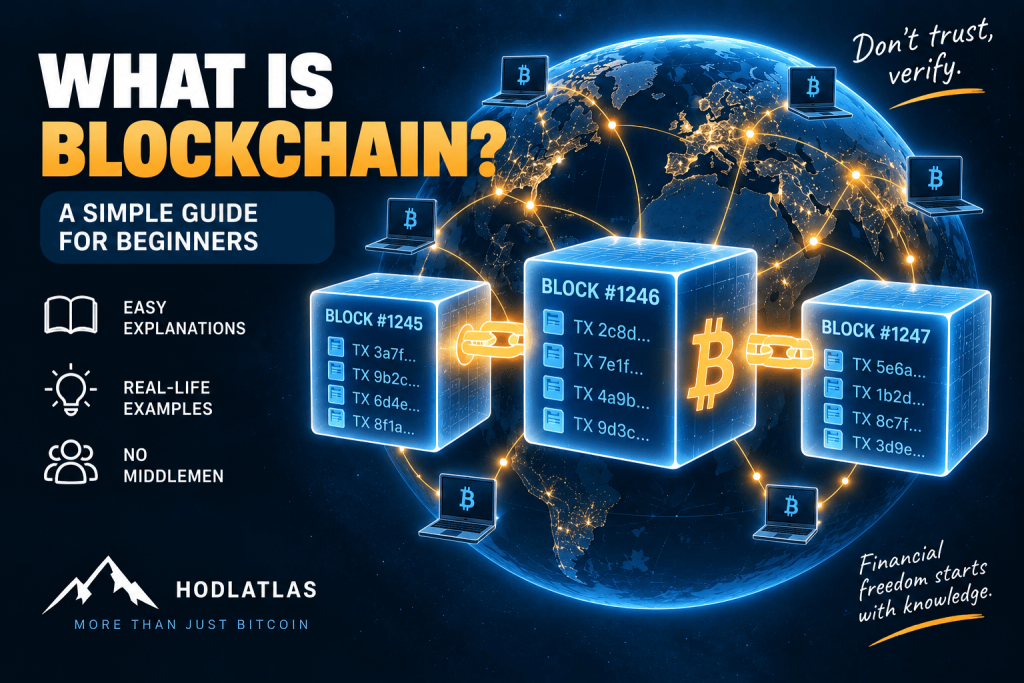
Put simply, the Bitcoin blockchain is a public history of confirmed transactions that is stored and verified by many independent computers around the world.
These computers are called nodes.
Each node can independently verify whether transactions follow Bitcoin’s rules. This means users do not have to rely on a single company or central server.
The word blockchain consists of two parts:
Block. A block contains a group of transactions along with other technical information.
Chain. Each new block is cryptographically linked to the previous block.
Over time, this creates a chronological sequence of blocks — the blockchain.
How Does It Work? A Simple Example
Imagine you want to send 0.005 BTC to a friend.
What happens behind the scenes?
1. Creating the Transaction
Your Bitcoin wallet creates a transaction and proves that you have the right to spend the corresponding bitcoin using your private key.
Your private key itself is never sent anywhere.
2. Broadcasting It to the Network
The transaction is broadcast to the Bitcoin network.
Nodes verify it according to Bitcoin’s rules: whether the digital signature is valid, whether the corresponding funds exist, and whether they have already been spent.
3. Waiting for Confirmation
After verification, the transaction may enter the pool of unconfirmed transactions known as the mempool.
Miners select transactions from this pool and use them to construct a candidate block.
4. Proof of Work
To add a new block to the blockchain, miners perform enormous amounts of computation through a mechanism called Proof of Work.
The miner that finds a valid solution first broadcasts the new block to the network.
5. Verifying the Block
Nodes independently verify the new block.
If it follows Bitcoin’s rules, they accept it and continue building the blockchain from it.
Your transaction now has its first confirmation. Each additional block adds another confirmation, making it increasingly difficult and expensive to alter the transaction’s history.
Why Is Bitcoin’s Transaction History So Difficult to Change?
Several mechanisms work together to protect Bitcoin’s history.
1. Decentralization
Bitcoin does not have a single central server containing the one “correct” database.
Thousands of independent nodes can verify Bitcoin’s rules and transaction history for themselves.
If someone simply changes information in their own copy of the blockchain, other participants do not have to accept those changes.
Validity is not determined by a simple majority vote among computers. Instead, every node independently verifies whether blocks and transactions follow the protocol rules.
2. Cryptographic Links Between Blocks
Every block contains a cryptographic reference — the hash of the previous block.
A hash can be thought of as a unique digital fingerprint of data.
If an old transaction were changed, the contents of its block would change, and so would its hash. The reference contained in the following block would then no longer match.
Changing old history would require redoing the Proof of Work for that block and all the blocks that came after it — while the honest network continues adding new blocks.
The deeper a transaction is buried in the blockchain, the more computational work protects its history.
Analogy: Imagine a tall tower of building blocks where every new block is connected to all the blocks below it. To replace a block near the bottom, you would have to rebuild everything above it while everyone else continues making the tower taller.
What Is a 51% Attack?
You may sometimes hear that attacking Bitcoin requires controlling “51% of the computers.” That is not quite correct.
It is not about the number of computers or nodes. It refers to controlling the majority of the network’s mining computational power, commonly called the hash rate.
With that much mining power, an attacker could potentially attempt to reorganize recent blocks or double-spend their own bitcoin.
However, even control over the majority of Bitcoin’s mining power would not allow an attacker to create a valid signature using someone else’s private key and simply steal their BTC.
Such an attack on Bitcoin would also require enormous computational and energy resources.
Why Is Blockchain Important for Bitcoin Holders?
Blockchain is more than just a technical database. It is the combination of the blockchain, cryptography, Proof of Work, and a network of independent nodes that allows Bitcoin to operate without a central bank.
For long-term Bitcoin holders, this provides several important properties.
Self-Custody
If your bitcoin is stored in a personal wallet and only you control the private keys, your BTC cannot be moved without the required cryptographic signature.
This is the idea behind the well-known Bitcoin principle:
Not your keys, not your coins.
That is why there is an important distinction between keeping Bitcoin on an exchange and holding it yourself.
Limited Supply
Bitcoin’s rules define a maximum supply of approximately 21 million BTC.
Nodes independently verify that these rules are followed. Someone cannot simply create additional bitcoin and force the network to accept them as valid.
This predictable issuance and limited supply are among Bitcoin’s most important characteristics.
Verifiability
Bitcoin’s transaction history is public.
Using a block explorer, you can check a transaction, see how many confirmations it has, view the transaction fee, and find the block in which it was included.
However, you do not have to trust a block explorer to verify the network. Running your own Bitcoin node allows you to independently verify Bitcoin’s rules and blockchain data.
This reflects one of Bitcoin’s most important principles:
Don’t trust, verify.
Blockchain and Bitcoin Are Not the Same Thing
There is one more important distinction to understand.
Bitcoin is not simply a blockchain.
The blockchain is only one part of the system. Without Proof of Work, miners, nodes, cryptography, consensus rules, and economic incentives, a chain of blocks alone would not have the properties that make Bitcoin unique.
It is therefore more accurate to think of blockchain as one of the mechanisms that allows the Bitcoin network to function.
Summary
✅The Bitcoin blockchain is a public and verifiable history of transactions organized into a chronological chain of cryptographically linked blocks.
✅ Copies of this history are maintained by independent participants, while every node can verify Bitcoin’s rules for itself.
✅ Together with Proof of Work, cryptography, and a decentralized network of nodes, this system allows Bitcoin to be transferred directly between participants without relying on a bank or another central intermediary.
✅ The core idea is simple: Instead of trusting a single middleman, Bitcoin allows you to verify the rules yourself.
Support the Project
HodlAtlas is free, ad-free, and has no affiliate links to exchanges — the site runs on voluntary donations from people who found the tools useful. If you'd like to support its development, you can send any amount in Bitcoin.
likablehacksaw535@walletofsatoshi.com